 Customer Login
 GRO Score

 Home
 About
 Products
 Investors
 Partners
 In The Media
 Contact Us
 Customer Login


What Are Emerging Markets? A Beginner's Guide for Indian Businesses & Investors
Discover how emerging markets create opportunities for Indian businesses and investors. Explore their risks and growth potential with UGRO Capital.
"Emerging markets" comes up constantly in discussions of global growth, investment, and trade, but the term is often used loosely. India is one of the most cited examples — and for UGRO Capital, it has a specific meaning too: Emerging Market (EM) describes UGRO's business serving micro-enterprises and small businesses across India's Tier-2 and Tier-3 markets through secured loans and Loan Against Property.
What Is an Emerging Market?
There is no single universal definition. The IMF distinguishes advanced economies from emerging market and developing economies, while investment indices apply their own methodologies. Broadly, an emerging market economy is one moving towards greater economic development, financial integration, industrialisation, and global participation — marked by rising incomes, expanding infrastructure, growing domestic businesses, rapid urbanisation, developing financial systems, deeper trade links, and fast technology adoption. The emerging market meaning is often misunderstood: "emerging" does not mean "poor" or "underdeveloped." It describes economies becoming increasingly important to global activity while still undergoing structural transformation, often alongside greater volatility in currencies, inflation, and capital flows.
Key Characteristics of Emerging Market Economies
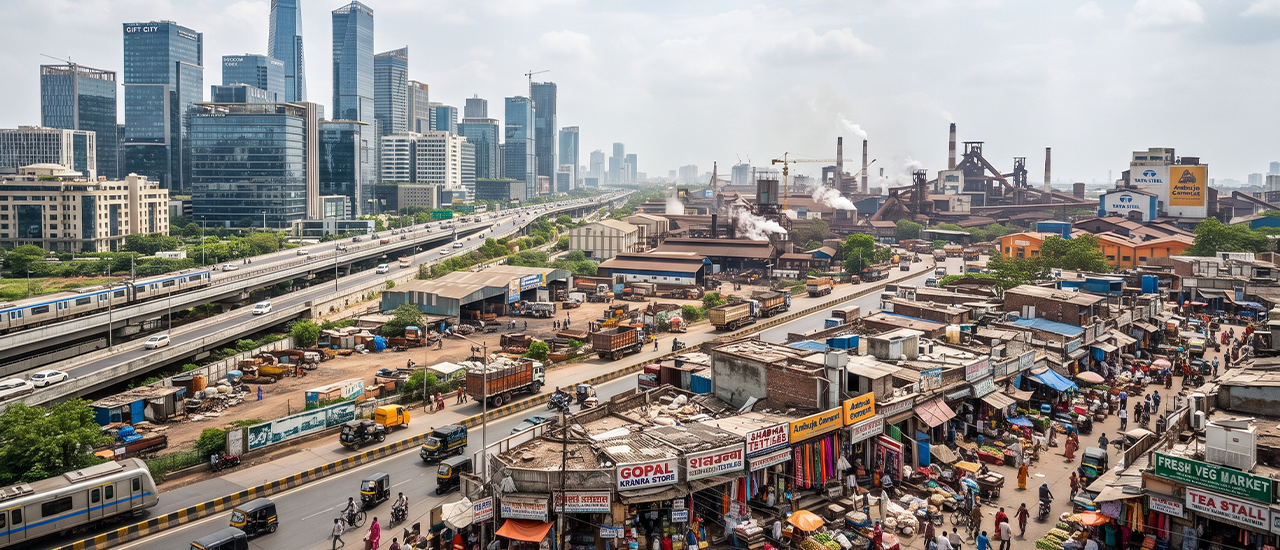
One defining feature of emerging market economies is structural growth opportunity — infrastructure still being built, formal finance still widening its reach, and businesses gradually shifting from informal to formal operating models. Technology accelerates this: a cash-dependent business may increasingly rely on digital payments, GST systems, and formal credit. Another defining feature is diversity — large corporations coexist with millions of micro, small, and medium enterprises that carry outsized weight in employment, local consumption, and distribution. This is exactly where the story becomes most relevant to India.
List of Major Emerging Markets Around the World
There is no single definitive list of emerging markets, since classifications vary by institution and index. Economies commonly associated with the category include:
- India
- China
- Brazil
- Indonesia
- Mexico
- South Africa
- Saudi Arabia
- Türkiye
- Thailand
- Malaysia
- Philippines
- Argentina
What these markets share is not an identical profile, but scale, growth potential, trade links, and financial integration. India stands out for its large domestic market, expanding infrastructure, technology adoption, manufacturing ambitions, and extensive MSME ecosystem.
Why Emerging Markets Matter to Businesses and Investors
Emerging markets matter because growth creates opportunity. As economies expand, businesses need capital — a manufacturer investing in machinery, a distributor adding inventory, a retailer opening another outlet. For investors, emerging markets offer exposure to economies with real long-term growth potential; for businesses, they represent new customers, suppliers, and markets. In India, this plays out beyond the metros: thousands of micro and small businesses across Tier-2 and Tier-3 towns are expanding operations, and collectively they form a critical part of the economy — the opportunity UGRO Capital addresses through its Emerging Market business, combining a 317-branch network with data-led underwriting via GRO Score 3.0.
Opportunities and Risks in Emerging Markets
Opportunities: rising consumption, expanding infrastructure, growing supply-chain participation, fast technology adoption, and rising demand for small-business financing as local enterprises formalise and scale.
Risks: greater economic and currency volatility, policy and regulatory shifts, and — for lenders — credit risk that demands disciplined underwriting and portfolio monitoring.
The opportunity, in other words, has to be weighed against these risks. For India's small businesses specifically, access to the right financing is what lets them act on growth opportunities as they arise — which is why the credit gap in India's small-business sector remains such a central part of the broader emerging-market story.
An emerging market, ultimately, is not defined only by how fast an economy grows. It is also defined by the businesses that grow with it.
Explore UGRO Capital's Emerging Market lending solutions to learn more.