
 Customer Login
 GRO Score

 Home
 About
 Products
 Investors
 Partners
 In The Media
 Contact Us
 Customer Login



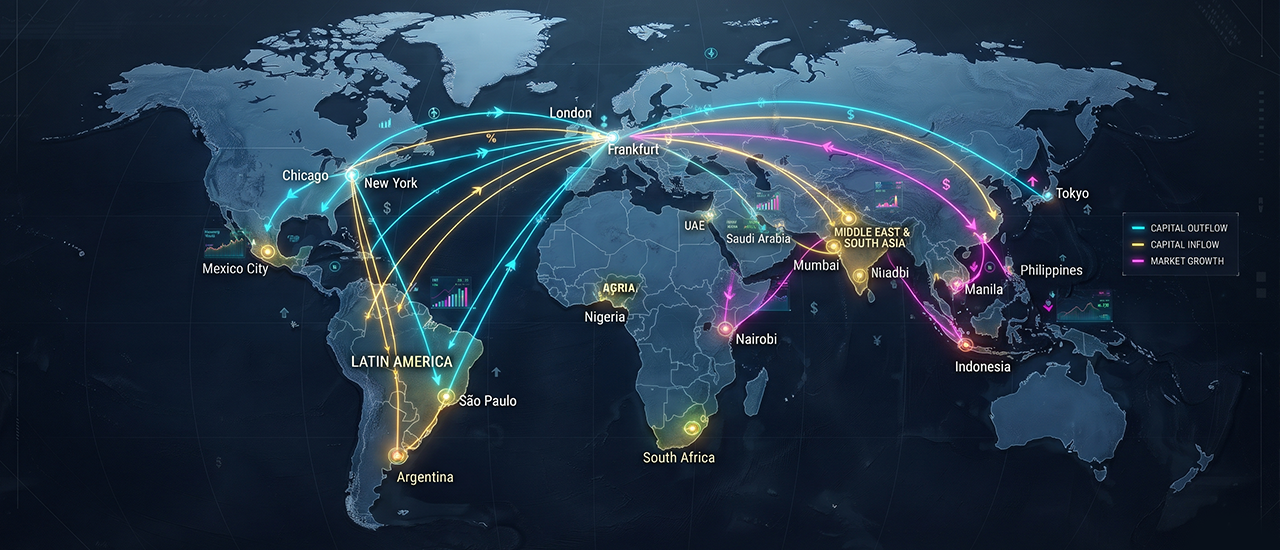
Why Investors Are Increasing Their Exposure to Emerging Markets in 2026
Understand emerging market investment trends for 2026, including fund flows, sector opportunities, and India's growth story. Explore UGRO Capital's guide.
For much of the last decade, emerging market allocations sat on the sidelines of most global portfolios. That is changing in 2026, and the shift shows up clearly in fund flows, equity performance, and the breadth of countries and sectors now in favour.
Growing Interest in Emerging Markets
Broad emerging-market ETFs pulled in close to $38.5 billion in the first half of 2026 alone, already ahead of the $35 billion gathered across all of 2025. January set the tone, with diversified emerging-market funds absorbing roughly $19 billion in a single month — the largest monthly haul on record for the category. Participation has been broad too: roughly three-quarters of emerging-market funds recorded inflows during the year, rather than gains being concentrated in one or two large vehicles.
Performance has reinforced the trend. Emerging-market equities have ranked among the best-performing segments of global markets in 2026, supported by a weaker U.S. dollar, expectations of further rate cuts in developed markets, and improving fundamentals across major emerging economies. A softer dollar tends to make emerging-market assets more attractive to foreign investors, since it lowers the currency-adjusted cost of exposure and often coincides with stronger local-currency returns.
Role of Emerging Market ETFs and Funds
Much of this year's inflow has moved through exchange-traded funds rather than direct stock-picking, reflecting how investors increasingly use low-cost, diversified vehicles to gain emerging-market exposure. Broad-based funds tracking major indices have led the way, with single-country ETFs — particularly those focused on South Korea and Brazil — also seeing unusually strong demand; 2026 flows into single-country emerging-market ETFs have already surpassed their totals for the whole of 2025.
This matters for two reasons. ETFs and funds make it easier for investors to size and adjust emerging-market exposure without single-stock risk, which helps explain the broad-based inflows. And rising fund flows are themselves a signal: as more capital moves through these vehicles, emerging-market funds gain liquidity and visibility, drawing in further allocations from investors who had previously stayed on the sidelines.
Sectors Attracting Global Investment
The emerging-market opportunity set has broadened well beyond its traditional technology tilt. Investors are now finding durable growth themes across AI infrastructure, power and energy transition, defence, healthcare, and advanced manufacturing. Rising AI-driven energy demand has created a parallel wave of investment in emerging-market power infrastructure, while advanced manufacturing hubs in North Asia and India are positioned to capture the next leg of global industrial and AI-related spending.
China continues to anchor its position through dominance in electric vehicles, batteries, and solar manufacturing. India's story looks different: while it has lagged peers like Taiwan and South Korea in AI software and chip-design exposure, it remains a strong draw for capex-driven sectors — manufacturing, transmission and distribution infrastructure, automobiles, and premium consumption — anchored by continued public investment and programmes such as Make in India and Production-Linked Incentives.
Emerging Market Trends to Watch in 2026
Rate expectations remain central: further easing from the U.S. Federal Reserve would likely keep the dollar soft and sustain the relative appeal of emerging-market assets. Sector leadership is also broadening, with power infrastructure, healthcare, and advanced manufacturing joining technology as credible long-term themes. Country-level differentiation is sharpening too, as investors distinguish between markets with strong AI and chip-manufacturing ecosystems and those, like India, whose opportunity is anchored more in domestic consumption, infrastructure capex, and manufacturing capacity.
That is where the emerging-market story connects back to the real economy. Behind every allocation to an emerging-market fund sits a broader universe of businesses — manufacturers, distributors, and service providers across India's towns and cities — that need capital to grow alongside the macro trend. This is the segment UGRO Capital focuses on through its Emerging Market business: secured lending and Loan Against Property for micro and small enterprises across Tier-2 and Tier-3 India, backed by a 317-branch network and data-led underwriting through GRO Score 3.0.
Global capital may flow through ETFs and funds, but on the ground, India's emerging-market growth is still built business by business.
Explore UGRO Capital's Emerging Market lending solutions to learn more.